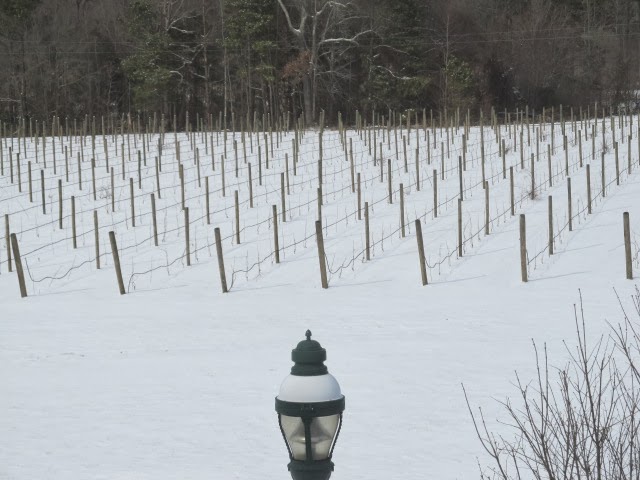
Though my rants and stories tend to center around the vineyard and my cows, making of the wine is the ultimate goal in any season. When harvest occurs back in September, it seems that all the work is done and winter time projects begin to take hold. However, during this time the grape juice is patiently going through its task of slowly fermenting, letting its solids drift to the bottom of the tank, and bringing on the character that will define its taste and aroma profile.
It has been about 6 months since we picked the grapes. Our Seyval Blanc came in with our first real harvest of just over a ton of grapes. We lost quite a few from a late season heat & humidity spell, tainting some of these grapes, and our reds were clobbered by the latent mold spores waiting for the opportune time to attack. But this is real farming, just as soybeans, corn, cotton, and peanuts are that are grown in the rest of the state.
Picking and crushing, along with destemming and initiating fermentation all occur on the same day. From there comes a series of steps that include pressing, more fermentation requirements, and a possible racking or two. And then it is time to wait for the process to take hold, expelling CO2 as the yeast does its thing by converting the sugars into alcohol. A month or so later we might rack again, which takes a few hours. This might be repeated several times before we finally decide to bottle. After 4 or 5 months we begin our taste tests, checking for mouth feel, acidity, alcohol level, and clarity. There are things we can do to pull some of these traits towards making the best wine possible. If there are particles still suspended in the wine after these rackings, we may add some Bentonite which helps clarify the wine........we will also send it through a filter just before bottling to provide one last opportunity at making the wine visibly clear and showing the color of the wine as it should be.
Rich and I were assigned bottling duty this year. It needs to be done while it is still relatively cool out, and before the vineyard pulls us in that direction for the next growing season. We found a day this past week, the fourth week in March, where it was just too cold and rainy to get anything really accomplished in the vineyard. So the winery found "willing volunteers" to get the bottling ready and in motion to bottle last fall's harvest. Bottling isn't hard but there are a few steps that need to be handled well, and with some kind of poetic balance between Rich and me so we don't trip over each other. We start by cleaning everything which takes a few hours. Tanks, pumps, hoses, fittings, machinery, and ultimately the bottles all need to be flushed with a sanitizing solution. Only then can we move forward and begin sending wine through the hoses to get to the filling machine. We have gone through these motions before, and each time we get a little more efficient. And each time we make notes on how to do it even better next time.
I have been chosen the "filling guy", using a 4-station filler to top off the bottles with the right amount of wine. From me the bottles are transferred to a side table adjacent to the capper where Rich puts a cap on top of the bottle, inserts it into the machine, which then spins a chuck down on the bottle simultaneously making threads in the cap as it seals and caps the bottle. We just bought a new capper chuck from Italy this year, and this was our first time at using it. It performed perfectly......we have found that the best winery equipment comes from Italy.
It took all day to bottle 762 bottles of our inaugural edition of our Seyval Blanc. It is not like a Pinot Grigio or a Chardonnay. It is not even like a Vidal Blanc, another white French hybrid. It has its own flavor. Some citrus, some grassiness, a hint of vanilla. Can't sell it yet, at least not until we get our state ABC license. For now it will have to mellow out in the bottle; Diane seems to think this will take about a month.
I remember staying on my Uncle's farm in the Catskills during the summers. He had a hundred or so Holsteins that he milked every day. When his family needed milk, he would bring out a pitcher and milk right into it, carrying the fresh white stuff into the house and putting it into the refrigerator for later consumption. We have started a tradition here, not unlike his. At the end of our bottling we had some wine that was the last to come through the hoses, or just a portion of a bottle that we wouldn't be capping. Rich filled a pitcher for our dinner that night, and it was very good even without the mellowing Diane is allowing.
Sunday, March 30, 2014
Friday, March 21, 2014
"Home Depot" Orange
We sort of proceeded according to plan today. Rich and I woke up at a respectable time (though not as early as in the heat of the summer). We prepped the tanks with the pre-emergent herbicide, checked to make sure there were't any clogs, which is normal for this gooey stuff, and got on our way.
We were about 5 miles into our 11 mile trek over to our other vineyard when I felt the steering wheel of the truck vibrate. Normally I would just blame it on a rough road, but I took a look in the mirror and quickly saw that one of the tires on the trailer had blown, and I mean really blown. It was obvious the tire was shredded....no quick plug to fix this tire. But our trailer has a double axial so without too much of a thought we proceeded on towards the vineyard. I did make one stop to inspect the tire, just to make sure I wasn't inheriting another tire problem. I wasn't, so we continued on to the vineyard.
Once there we made the decision to continue on plan and start spraying Block 1. I had never used this tank and wand configuration before for ground spraying, so I didn't know our spray rate. Rich took the gun and we started crawling down and up the rows as he sprayed this bright orange herbicide on the strip just under the wires. The tractor was in low and in first gear....a baby could have run faster. But with all the spraying Rich needed to do, that was about as fast as we could go. A good spraying now will relieve us of days upon days of weed whacking in the summer.
As you would figure, our 50 gallon tank ran dry only halfway into Block One. We had only sprayed 1 1/2 acres of vineyard, and needed to make a new batch to continue. The chemicals were back at the other place (figures @#@!@#) and we had that flat to resolve. Our first thought was to take off the tire, drop it off at the local equipment place, head over to White Oak Farm and grab the chemicals we needed, and then return. As one would guess, we tripped down to Plan B right away when we realized that we didn't have a jack or a wrench that would work on the trailer. Sooooo we went straight to the farm to retrieve those items, and the chemicals, and returned to the vineyard.
Rich worked on removing the bad tire, while I went over and started mixing the chemicals in the tank with water. Plan C came on very quickly when I found out my tenant (there is a house on the vineyard that I rent out) had decided to leave the house with the main breaker for the well pump turned off. We had no water, so I couldn't mix a tank of the orange stuff.
Oh, I hate going to Plan C because it basically means the afternoon was a bust. Rich and I went over to have a new tire put on the rim just as Duke was upset in the NCAA tourney. Rich returned to the farm as I went back to the vineyard, remounted the tire, re-strapped the tractor up on the trailer, and returned to the farm.
Tomorrow is another day to try it all over again.
We were about 5 miles into our 11 mile trek over to our other vineyard when I felt the steering wheel of the truck vibrate. Normally I would just blame it on a rough road, but I took a look in the mirror and quickly saw that one of the tires on the trailer had blown, and I mean really blown. It was obvious the tire was shredded....no quick plug to fix this tire. But our trailer has a double axial so without too much of a thought we proceeded on towards the vineyard. I did make one stop to inspect the tire, just to make sure I wasn't inheriting another tire problem. I wasn't, so we continued on to the vineyard.
Once there we made the decision to continue on plan and start spraying Block 1. I had never used this tank and wand configuration before for ground spraying, so I didn't know our spray rate. Rich took the gun and we started crawling down and up the rows as he sprayed this bright orange herbicide on the strip just under the wires. The tractor was in low and in first gear....a baby could have run faster. But with all the spraying Rich needed to do, that was about as fast as we could go. A good spraying now will relieve us of days upon days of weed whacking in the summer.
As you would figure, our 50 gallon tank ran dry only halfway into Block One. We had only sprayed 1 1/2 acres of vineyard, and needed to make a new batch to continue. The chemicals were back at the other place (figures @#@!@#) and we had that flat to resolve. Our first thought was to take off the tire, drop it off at the local equipment place, head over to White Oak Farm and grab the chemicals we needed, and then return. As one would guess, we tripped down to Plan B right away when we realized that we didn't have a jack or a wrench that would work on the trailer. Sooooo we went straight to the farm to retrieve those items, and the chemicals, and returned to the vineyard.
Rich worked on removing the bad tire, while I went over and started mixing the chemicals in the tank with water. Plan C came on very quickly when I found out my tenant (there is a house on the vineyard that I rent out) had decided to leave the house with the main breaker for the well pump turned off. We had no water, so I couldn't mix a tank of the orange stuff.
Oh, I hate going to Plan C because it basically means the afternoon was a bust. Rich and I went over to have a new tire put on the rim just as Duke was upset in the NCAA tourney. Rich returned to the farm as I went back to the vineyard, remounted the tire, re-strapped the tractor up on the trailer, and returned to the farm.
Tomorrow is another day to try it all over again.
It Really Stinks, But Someone Has To Do It
We've finished our general trellis repair and now it's time to get to the spraying. We have about 9 acres of grapes now, in two locations, so the spraying is going to take quite some time. And it's not just one type of spraying, but three.
Rich is seen in the photo, spraying lime sulfur with a hand held wand on each of the grapevines. It is a boring process, but he is listening to Led Zeppelin or some other oldie on his iPod as he waves the wand over the trunk, cordons, and spurs. What we are trying to do here is attack latent fungus from the previous season, and to do this all the exposed wood is being saturated with a lime sulfur solution while still in the dormant stage. The lime sulfur smells like rotten eggs, and no matter how careful you are, or how covered you try to be, the smell permeates everything and stays in you nostrils for days.
My job is to ride the tractor, pulling the spray tank behind me. Rich yells at me a lot, as I go too fast or go too slow tugging on the hose he is holding in his hand. His real goal is to get back and watch the NCAA basketball tourney in the afternoon and it's my purpose stay ahead of him at his pace. Not that easy when you figure each vine is different and requires more or less attention by Rich to do the spraying properly. It is not just setting the gear speeds and steering the machine; my neck will ache for a week from constantly turning to see exactly where he is.
Tomorrow we start spraying the pre-emergent under the vines. We use a chemical called Surflan, which leaves a bright orange stripe under the wire......almost makes it look like the soil was tilled. This stuff prevents new weeds from germinating in the next few weeks as Spring comes upon us. We have the equivalent of 2 1/2 solid acres to spray with a wand....it'll take forever.
Rich is seen in the photo, spraying lime sulfur with a hand held wand on each of the grapevines. It is a boring process, but he is listening to Led Zeppelin or some other oldie on his iPod as he waves the wand over the trunk, cordons, and spurs. What we are trying to do here is attack latent fungus from the previous season, and to do this all the exposed wood is being saturated with a lime sulfur solution while still in the dormant stage. The lime sulfur smells like rotten eggs, and no matter how careful you are, or how covered you try to be, the smell permeates everything and stays in you nostrils for days.
My job is to ride the tractor, pulling the spray tank behind me. Rich yells at me a lot, as I go too fast or go too slow tugging on the hose he is holding in his hand. His real goal is to get back and watch the NCAA basketball tourney in the afternoon and it's my purpose stay ahead of him at his pace. Not that easy when you figure each vine is different and requires more or less attention by Rich to do the spraying properly. It is not just setting the gear speeds and steering the machine; my neck will ache for a week from constantly turning to see exactly where he is.
Tomorrow we start spraying the pre-emergent under the vines. We use a chemical called Surflan, which leaves a bright orange stripe under the wire......almost makes it look like the soil was tilled. This stuff prevents new weeds from germinating in the next few weeks as Spring comes upon us. We have the equivalent of 2 1/2 solid acres to spray with a wand....it'll take forever.
Monday, March 10, 2014
Time To Get Serious
I've pushed off going out into the vineyard for a couple of months now. It has been just too cold, or the cows have taken up all my time, or Rich isn't here yet to help out. It's been any number of excuses.
But today was a warm day, and the next two days will be even warmer....upper 60's and maybe even a 70 degree day if we're lucky. So I started collecting the tools I need and some of the repair parts required to venture back into the vineyard. This all needs to be done before bud break. Rich reminded me that the "traditional" bud break date of April 1st hasn't been valid for the last few years.....more like April 15th. So that gives us a month to get everything done. And with the late snowfall we have received, he is likely to be correct on his prediction.
We are starting slowly here. There is some very much required work to be done with repairing the trellis system for our Norton grapes. We have a T-trellis system (the trellis looks like the letter T), which is more or less a requirement for really aggressive grapes. When we first put it in we did a combination of wooden posts and metal posts just as an experiment. Well, the metal posts just can't stand the lateral forces of a hurricane, and we had an entire row tip over on us when Irene came around. We are finally now getting to replace these metal posts with the time proven wooden posts.
The metal "T's" on top of the wooden posts twisted with the wind forces, and these are all being replaced with 4" x 4"'s with steel bracing. It takes quite awhile to make each one of these in the shop, and then we have to go into the vineyard and remove the metal T and then reassemble using the new improved version. We were only able to repair one row today with these new top T's.
We next went down the row with the bent metal posts, having to manually dig holes for each of our replacement wooden posts. The positioning wouldn't allow us to bring in the tractor and use the hydraulic post driver to do this work....too many wires and vines in the way to jockey the tractor in position. The ground was still a little damp, so digging down 2 1/2 feet wasn't too bad. We replaced 7 posts (certainly this was one of the shorter rows) and will next need to assemble the new 4" x 4"'s on top to form the T's.
There is still pruning to do on the Nortons....we had been waiting to complete the repairs first. And then we noticed the irrigation system was a mess. It was broken in a number of areas....was this because of the icing and the possible freezing of the lines, shattering the PVC, or was this due to mischief ? I'll make that determination later when I starting evaluating the extent of the damage.
Wednesday is Richmond's Wineries Unlimited Tradeshow, where they promote all the new "toys" for the winery industry. This year they have invited brewery equipment makers to display their processing equipment; this is of special interest to Rich because he is starting to tinker with producing his own beer. He is thinking of setting up a micro brewery next to our winery. We'll see where that leads after we try some of the beer he is making in a 5 gallon carboy that is gurgling in our kitchen.....taste tests in about a week.
And early next week we have our Seyval Blanc to bottle from the grapes we harvested last fall. We have enough to make 50 cases or so. During the winter we purchased a new Italian screw topper for 750 mL bottles and I am excited to see how that works when we bottle this white wine.
But today was a warm day, and the next two days will be even warmer....upper 60's and maybe even a 70 degree day if we're lucky. So I started collecting the tools I need and some of the repair parts required to venture back into the vineyard. This all needs to be done before bud break. Rich reminded me that the "traditional" bud break date of April 1st hasn't been valid for the last few years.....more like April 15th. So that gives us a month to get everything done. And with the late snowfall we have received, he is likely to be correct on his prediction.
We are starting slowly here. There is some very much required work to be done with repairing the trellis system for our Norton grapes. We have a T-trellis system (the trellis looks like the letter T), which is more or less a requirement for really aggressive grapes. When we first put it in we did a combination of wooden posts and metal posts just as an experiment. Well, the metal posts just can't stand the lateral forces of a hurricane, and we had an entire row tip over on us when Irene came around. We are finally now getting to replace these metal posts with the time proven wooden posts.
The metal "T's" on top of the wooden posts twisted with the wind forces, and these are all being replaced with 4" x 4"'s with steel bracing. It takes quite awhile to make each one of these in the shop, and then we have to go into the vineyard and remove the metal T and then reassemble using the new improved version. We were only able to repair one row today with these new top T's.
We next went down the row with the bent metal posts, having to manually dig holes for each of our replacement wooden posts. The positioning wouldn't allow us to bring in the tractor and use the hydraulic post driver to do this work....too many wires and vines in the way to jockey the tractor in position. The ground was still a little damp, so digging down 2 1/2 feet wasn't too bad. We replaced 7 posts (certainly this was one of the shorter rows) and will next need to assemble the new 4" x 4"'s on top to form the T's.
There is still pruning to do on the Nortons....we had been waiting to complete the repairs first. And then we noticed the irrigation system was a mess. It was broken in a number of areas....was this because of the icing and the possible freezing of the lines, shattering the PVC, or was this due to mischief ? I'll make that determination later when I starting evaluating the extent of the damage.
Wednesday is Richmond's Wineries Unlimited Tradeshow, where they promote all the new "toys" for the winery industry. This year they have invited brewery equipment makers to display their processing equipment; this is of special interest to Rich because he is starting to tinker with producing his own beer. He is thinking of setting up a micro brewery next to our winery. We'll see where that leads after we try some of the beer he is making in a 5 gallon carboy that is gurgling in our kitchen.....taste tests in about a week.
And early next week we have our Seyval Blanc to bottle from the grapes we harvested last fall. We have enough to make 50 cases or so. During the winter we purchased a new Italian screw topper for 750 mL bottles and I am excited to see how that works when we bottle this white wine.
Sunday, February 16, 2014
Winter Is Behind Us
As I write this I am looking out of the same window where I took this picture just a few short days ago. The ground is clear now, and the temperature is predicted to be 67 degrees by Wednesday. It is now time to play catch up in the vineyard. I still have plenty of dormant pruning to do, which was side-lined as I spent my winter chasing after cows and putting up electric fence. There is much to do in the vineyard other than just pruning. I have 2 rows of vines that were flipped during a hurricane and all those posts are in need of replacement. The irrigation system has been compromised by the severely cold temperatures we had, which caused ruptures in lines where the water wasn't drained fully. Several of our hydrants cracked too, so I need to dig down to the water lines and replace the junctions with underground cutoff valves, which hopefully will prevent a repeat in the future.
We are also gearing up for the Winery to be built this year. The ground is a little mushy now, so it is still too early to bring out the heavy equipment. All goes well we can be starting the actual foundation work in May. It'll be a 4 month project. Getting the place geared up for visitors and tourists has its own priority. Making the winery and vineyard family friendly takes on a mission of its own.
It is more work than Diane, Rich, and I can take on all by ourselves. I am posting internships for those that want to learn about the process.....vineyards, new business venture, tourist attraction, small-scale farming....there is so much to do and learn for someone with an interest. We'll offer room & board and a small allowance.
Diane is still up in Massachusetts, having shoveled even more snow earlier today on top of the recent blizzards. I can hear it in her voice that the weather, and being away from our Virginia home, is wearing thin. Hopefully the house will sell early this Spring.
Monday, December 30, 2013
Cow Tails From The Vineyard: It's All About The Moos
It is a rather slow time in the vineyard. Rich has finished weed wacking all of Block 2, and when the weather permits I will get out there and finish our first pruning on Block 1....I am about half done.
Rich headed back up north today. Christmas just passed and he wanted to be back up in New England for New Years and to help out at Fenway as they use the baseball field for winter hockey. "We" also need to do some repairs with the trellis system in our Nortons. I say "we" because Rich gave me instructions on what he needs to have done before he comes back down to kick start the 2014 season.
But now about the Moos. There are three different kinds of Moos. There may be more but I have only begun to recognize these first three. There is the "I am really hungry" moo, there is the "Where is my calf?" moo, and then there is the "Someone is or will soon break out of the pasture" moo.
It is very important to recognize these moos, for to ignore them will lead to certain disaster and an evening full of frustration and disappointment. It is always better to declare DEFCON 1. the highest alert status possible, than hoping for the best and assume nothing is going to happen. There are mere minutes between a red alert Moo and total chaos.I was on the unfortunate side of this error in judgement the other night, and though the final result was positive, it made for a nightmare of a night.
It really began earlier in the day. We had three jailbreaks during daylight hours, and three times Chris, Rich, and I were within the width of the field as we saw the cows jump or break fences. For each of these we managed to get the cows back in the field, and subsequently repair the fences. The fact is that if a cow wants to jump a fence (it's more like a WWF body slam), they will do it even knowing it might make a mark in their suede coat. Barbed wire is a joke.
We had gone around inspecting the fence one last time before dinner, and we had just polished off our last glass of wine when a fellow farmer called me on the phone and suggested that there were some cows loose (red ones at that) and they had been seen by a neighbor maybe a half mile away from our fields. The point here was that we had heard a moo at around 6 and blew it off. The call came in at around 6:30. Knowing the daily history of our cattle, and also knowing I am the only red angus breeder in this area, putting 2 + 2 together was not difficult.
Chris and I threw on our jackets and proceeded to walk up the main road towards where we were told the cattle were last seen. On our trip there a pick up truck approached us from behind and stopped. It was another concerned farmer who had received the same call.....he was going to check on his gates to see if there had been an escape by his cows. The verdict came quickly....his cows were still in, mine were huddled against the woods near his cattle just plotting their next move. By this time they had walked another half mile further away. Walking to get to them now was out of the question. It was time to get the truck and see if, by holding a bucket of corn while riding the tailgate, we could entice them to turn around on their exodus and return home. It was a trial that turned unsuccessful. It worked for a few hundred yards, but then the lead cow became disinterested in all carrot and no feed, so it suddenly veered off to the side pasture, taking all 7 cows and calves with it. They even stopped at a home and decided to take a loop around their barn and house, leaving cow plops along the way. We even let the leader (U204) have a nibble, but once the pail was emptied it no longer held her interest. Obviously this approach wasn't working; time for Plan B.
We now left the truck back at the beginning, where by now the cattle had reversed themselves and returned to. Chris was to walk on one side, I on the other to see if we could turn them. We were able to reverse them and sort of get them headed in the right direction. It was hurtful to watch. A cow's straight line did not resemble any I had ever drawn. A stop over at a pump house to nibble on some uncut weeds around its parameter. Another walk back out to the road slowing a few cars who saw the animals wandering around the asphalt. Rich by now had shown up in the ATV, where he and Chris changed roles. Chris became our resident cowboy as he motored up the right side of the herd "keeping them" from taking a side exit into the woods. This worked well until he dropped into a ditch, whereby he needed to be towed out later after we got the cows home.
The cows now had taken the last turn in the road and probably recognized their fate. They saw the house in the distance and kept a steady pace along the side of the road. Cars were now backed up a few hundred yards up, and the one I talked to shared with me her loose cow stories. She appreciated the mess we were in, but at that point it almost looked like we had it under control. The cows continued, and turned up our driveway headed right to the front of the house, a site they were quite familiar with from previous adventures. So much so that they knew that here was the best grass in the area, and the cul de sac in front became a stopping place to eat up some relatively tall grass. Compared to the dead or dying grass in the fields it must have been almost gourmet like. We, along with the calves, were tired. To let them munch on grass at this juncture was welcome. The calves either lied down or decided a nice warm milk meal was needed. For thirty minutes we all stayed still. I was trying to decide how long we were going to let this go on. We were in control, weren't we ?
But the "driver" in Rich came forward. His patience had run out so he decided to start pushing them to the gate they had broken through. By this time I was in a nice warm truck keeping the headlights pointed on the cattle. Chris created a border on the backside and also ran ahead to open the gate for easy access. It wasn't so easy though; it is much easier to open repaired gates in the daylight than in total darkness. We got them in finally, and proceeded to mend the fence once again. I went and got a couple bales of hay and Chris and I moved them to the middle of the field thinking that that would keep them in for the rest of the night. Little did we know.
The next morning I was greeted in my back yard by the four cows. They were mooing loudly. Seems that they were able to crack the code to get out, but the repairs were too tough for the calves to figure out so they stayed behind (personally I think they fell asleep inside the pasture fences while their mothers had another "Mom's Night Out"). These were the "Where are my calves?" moo that I was hearing after having only a few hours sleep following our exciting evening of events.
I talked to them, like a parent who was just too tired to lecture anymore. All of us went over to the gate and with some coaching, got them to go in without the calves deciding to run out. It all ended where it all began. The cows had their night on the town. Between the 2nd jailbreak and their really unproductive tour of the neighborhood that finished with their eating my front lawn, they were full and spent the day resting and plotting their next move. Need less to say, Chris, Rich, and I spent that day fixing the fence and planning on installing electric. The cows may have won the battle (or at least tied). I will win the war. The next cow that decides to explore the world in the name of the Queen may be dubbed Sir Loin of Elberon !
Rich headed back up north today. Christmas just passed and he wanted to be back up in New England for New Years and to help out at Fenway as they use the baseball field for winter hockey. "We" also need to do some repairs with the trellis system in our Nortons. I say "we" because Rich gave me instructions on what he needs to have done before he comes back down to kick start the 2014 season.
But now about the Moos. There are three different kinds of Moos. There may be more but I have only begun to recognize these first three. There is the "I am really hungry" moo, there is the "Where is my calf?" moo, and then there is the "Someone is or will soon break out of the pasture" moo.
It is very important to recognize these moos, for to ignore them will lead to certain disaster and an evening full of frustration and disappointment. It is always better to declare DEFCON 1. the highest alert status possible, than hoping for the best and assume nothing is going to happen. There are mere minutes between a red alert Moo and total chaos.I was on the unfortunate side of this error in judgement the other night, and though the final result was positive, it made for a nightmare of a night.
It really began earlier in the day. We had three jailbreaks during daylight hours, and three times Chris, Rich, and I were within the width of the field as we saw the cows jump or break fences. For each of these we managed to get the cows back in the field, and subsequently repair the fences. The fact is that if a cow wants to jump a fence (it's more like a WWF body slam), they will do it even knowing it might make a mark in their suede coat. Barbed wire is a joke.
We had gone around inspecting the fence one last time before dinner, and we had just polished off our last glass of wine when a fellow farmer called me on the phone and suggested that there were some cows loose (red ones at that) and they had been seen by a neighbor maybe a half mile away from our fields. The point here was that we had heard a moo at around 6 and blew it off. The call came in at around 6:30. Knowing the daily history of our cattle, and also knowing I am the only red angus breeder in this area, putting 2 + 2 together was not difficult.
Chris and I threw on our jackets and proceeded to walk up the main road towards where we were told the cattle were last seen. On our trip there a pick up truck approached us from behind and stopped. It was another concerned farmer who had received the same call.....he was going to check on his gates to see if there had been an escape by his cows. The verdict came quickly....his cows were still in, mine were huddled against the woods near his cattle just plotting their next move. By this time they had walked another half mile further away. Walking to get to them now was out of the question. It was time to get the truck and see if, by holding a bucket of corn while riding the tailgate, we could entice them to turn around on their exodus and return home. It was a trial that turned unsuccessful. It worked for a few hundred yards, but then the lead cow became disinterested in all carrot and no feed, so it suddenly veered off to the side pasture, taking all 7 cows and calves with it. They even stopped at a home and decided to take a loop around their barn and house, leaving cow plops along the way. We even let the leader (U204) have a nibble, but once the pail was emptied it no longer held her interest. Obviously this approach wasn't working; time for Plan B.
We now left the truck back at the beginning, where by now the cattle had reversed themselves and returned to. Chris was to walk on one side, I on the other to see if we could turn them. We were able to reverse them and sort of get them headed in the right direction. It was hurtful to watch. A cow's straight line did not resemble any I had ever drawn. A stop over at a pump house to nibble on some uncut weeds around its parameter. Another walk back out to the road slowing a few cars who saw the animals wandering around the asphalt. Rich by now had shown up in the ATV, where he and Chris changed roles. Chris became our resident cowboy as he motored up the right side of the herd "keeping them" from taking a side exit into the woods. This worked well until he dropped into a ditch, whereby he needed to be towed out later after we got the cows home.
The cows now had taken the last turn in the road and probably recognized their fate. They saw the house in the distance and kept a steady pace along the side of the road. Cars were now backed up a few hundred yards up, and the one I talked to shared with me her loose cow stories. She appreciated the mess we were in, but at that point it almost looked like we had it under control. The cows continued, and turned up our driveway headed right to the front of the house, a site they were quite familiar with from previous adventures. So much so that they knew that here was the best grass in the area, and the cul de sac in front became a stopping place to eat up some relatively tall grass. Compared to the dead or dying grass in the fields it must have been almost gourmet like. We, along with the calves, were tired. To let them munch on grass at this juncture was welcome. The calves either lied down or decided a nice warm milk meal was needed. For thirty minutes we all stayed still. I was trying to decide how long we were going to let this go on. We were in control, weren't we ?
But the "driver" in Rich came forward. His patience had run out so he decided to start pushing them to the gate they had broken through. By this time I was in a nice warm truck keeping the headlights pointed on the cattle. Chris created a border on the backside and also ran ahead to open the gate for easy access. It wasn't so easy though; it is much easier to open repaired gates in the daylight than in total darkness. We got them in finally, and proceeded to mend the fence once again. I went and got a couple bales of hay and Chris and I moved them to the middle of the field thinking that that would keep them in for the rest of the night. Little did we know.
The next morning I was greeted in my back yard by the four cows. They were mooing loudly. Seems that they were able to crack the code to get out, but the repairs were too tough for the calves to figure out so they stayed behind (personally I think they fell asleep inside the pasture fences while their mothers had another "Mom's Night Out"). These were the "Where are my calves?" moo that I was hearing after having only a few hours sleep following our exciting evening of events.
I talked to them, like a parent who was just too tired to lecture anymore. All of us went over to the gate and with some coaching, got them to go in without the calves deciding to run out. It all ended where it all began. The cows had their night on the town. Between the 2nd jailbreak and their really unproductive tour of the neighborhood that finished with their eating my front lawn, they were full and spent the day resting and plotting their next move. Need less to say, Chris, Rich, and I spent that day fixing the fence and planning on installing electric. The cows may have won the battle (or at least tied). I will win the war. The next cow that decides to explore the world in the name of the Queen may be dubbed Sir Loin of Elberon !
Friday, December 13, 2013
Vines Are Like Charlie Brown's Christmas Tree
For the first time Rich and I have gotten out in the fields before the new year has started, to prep the vines for 2014. There still is some major catching up to do, projects that were put on the back burner while we hurried ourselves through the harvest season. Rich is weedwacking 7 acres of weeds that ran amuck last Fall. I have started to prune the vines; this will be the first pruning of two that will need to be done before bud break next year. After Rich completes his assignment we will spray under the wires to kill off any winter weeds (trust me, there are plenty) and put down a pre-emergent to prevent new growth. We hope this year we can keep ahead of the weed problem using herbicides alone......we'll see I guess.
As you squint your eyes looking at the above picture, you can see vertical canes that are a good 8" to 10" above the cordon (the horizontal arms). We keep them long to prevent winter born viruses from getting down to the budding region; they will be shortened when we do our 2nd pruning. It is during this second pruning when we do our bud count; we want 2 buds per cane and we are trying to have 6 canes on each side of the trunk. This provides 24 opportunities for shoot growth on each vine, all growing upwards vertically to fill out the trellis.
Winter in Virginia is a strange combination of some really pleasant weather with days in the 50's to what seems to be a series of cold snaps where the temperature never gets above 30. Compared to Syracuse or New England this must seem quite balmy, but when you have to be in the fields working with your bare hands as you prune and tie up vines, it can be numbing on the fingers. Though there are periods when we think we have caught up on our work and our projects work their way in doors (i.e. an unheated barn), taking care of vines is a year round job.
Somehow we also have to find time to put up new fencing for the cattle. T29's calf likes to squeeze through the barbed wire and walk the backside of the fence. Why, I don't know other than wanting to relive the experience it had with being born in the "outside world".
There is a winery to be built in 2014 too.
As you squint your eyes looking at the above picture, you can see vertical canes that are a good 8" to 10" above the cordon (the horizontal arms). We keep them long to prevent winter born viruses from getting down to the budding region; they will be shortened when we do our 2nd pruning. It is during this second pruning when we do our bud count; we want 2 buds per cane and we are trying to have 6 canes on each side of the trunk. This provides 24 opportunities for shoot growth on each vine, all growing upwards vertically to fill out the trellis.
Winter in Virginia is a strange combination of some really pleasant weather with days in the 50's to what seems to be a series of cold snaps where the temperature never gets above 30. Compared to Syracuse or New England this must seem quite balmy, but when you have to be in the fields working with your bare hands as you prune and tie up vines, it can be numbing on the fingers. Though there are periods when we think we have caught up on our work and our projects work their way in doors (i.e. an unheated barn), taking care of vines is a year round job.
Somehow we also have to find time to put up new fencing for the cattle. T29's calf likes to squeeze through the barbed wire and walk the backside of the fence. Why, I don't know other than wanting to relive the experience it had with being born in the "outside world".
There is a winery to be built in 2014 too.
Subscribe to:
Posts (Atom)

.jpg)